Wednesday, March 4, 2020

UCLan’s cJAM Media Event, Friday 22 November

The games design course was excited to take part in cJAM: Media last week!
The event that enables our talented students to meet face-to-face with senior industry professionals, to share ideas, make connections and pitch for opportunities.
cJAM events are hosted by the Faculty of Culture and the Creative Industries and the objective is to give our students the opportunity to win placements that will help launch their careers.

The day included:
FREE breakfast and lunch

Giant speed pitching session

Chance to win industry placements

Industry guest speakers

Industry Q&A panel

Networking throughout.

We were so proud to welcome our Alumni, Saija Wintersun, now Senior Environment Artist at Rebellion, Oxford.
Saija spent much of the day reviewing student portfolios and offering her expert advice.


The Creative Innovation Zone in UCLan's Media Factory was buzzing with conversation as hundreds of students queued for 'speed dating' style interviews with their industry heroes and mentors.

See details of the programme HERE.

Tania Callagher, UCLan Resources Co-ordinator and Richard Albiston, Creative Producer of The Great Northern Creative Expo, must be given utmost credit for arranging this inspiring and exhuberent event which led to 88 placements being awarded to Media students.






Monday, February 24, 2020

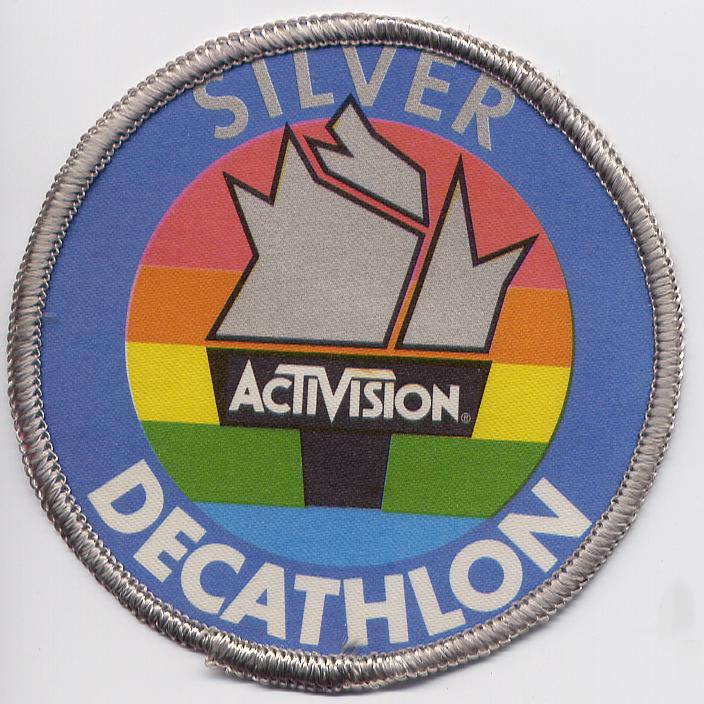
AZ 030, The Activision Decathlon!

Welcome back to the show! I hope you all enjoyed the holidays, now we're back to playing Atari 2600 games every two weeks until I screw something up. The first game of 2020 is the Activision Decathlon by the amazing David Crane. I hope you enjoy the show. Next up will be Moon Patrol by Atari, so if you have any feedback on that game, please send it to 2600gamebygame@gmail.com by the end of the day 26th January. Thanks so much for listening!

Brand new Discord server! Why
Decathlon on Random Terrain
David Crane article by Tony Tyler, Big K magazine April 1984
David Crane article by Colin Calvert, Hi-Res magazine January 1984
From the Digital Press Activision Patch page:
Decathlon Bronze patch
Letter with Bronze patch
Decathlon Silver patch
Letter with Silver patch
Decathlon Gold patch
Letter with Gold patch
Atari Age Decathlon with Driving controller thread
Atari Age Decathlon Training Suit thread
Decathlon glove on Atarimania
Bugler's Dream by Leo Arnaud

Friday, February 21, 2020

SuperStarfighter, A Local Multiplayer Game Made With Godot

Looks like FOSS game development with Godot is a breeze :)
SuperStarfighter is a fast-paced local party game for up to 4 players. Outmaneuver and shoot your opponents in a 2d top-down arena, and become an intergalactic champion!


Get it on Itch.io or find the source code here.

Hat-tip to GoL.

For commenting please visit our forums.

Thursday, February 20, 2020

Cortex Command Releases Code Under The AGPL V3


Cortex Command is a mess, but in a good way. This bizarrely entertaining strategy blend has been undergoing continuous development since the early 2000s, having had its first main release in 2012. Seven years later, its creators decided it's time to let the community have a say.

Just one day ago developer Data Realms announced on the game's Steam page it was freeing the game's code under the GNU Affero License v3. While this release does not include any of the game's data or graphics, meaning you still have to purchase a full copy or replace them with your own, it is nevertheless welcoming news to see game studios embracing Free Software licensing, enabling users to modify the game at their own will.

The game itself is as fun as ever. An ungodly hybrid between X-COM, Terraria, and Starcraft, Cortex Command is one of those games whose chaotic approach to physics simulation can lead to some pretty hilarious moments. The game pits several factions in a messy planetary war for resources. The rest is up to the player to discover and go bonkers.

So if you do not mind about the proprietary data, by all means have a try. You can currently purchase the game for about 20 USD on the developer's website (linked above). The code can be accessed on the github page for the project.

Code license: AGPLv3
Assets license: Proprietary

Comments? Check out the forum thread.

Storium Basics: Overview

Today's article - and the next several - are going to be of a different sort than what I've done so far on this blog. Today, I'm beginning a series I'll call "Storium Basics." This series is targeted at new Storium players rather than those who already know a bit about it and want to explore it further. It is drawn from my writing for beginners' games that I have run. This series will largely be targeted at the player side of Storium, rather than the narrator side, but should help either come to a general understanding of how the system works.

If you are a new player, I hope that these articles will be helpful for you and help you get started in Storium. If you find these interesting and want to explore further, please take a look at my prior articles on this blog - I've written on quite a lot of different topics since starting up, and there will be articles that explore issues I raise here in more detail. I will try to link to articles that I feel could provide additional help as I go through these basics.

First up, let's take a look at the first question a player will want answered: What is Storium, anyway?

Storium is a play-by-post storytelling game where the players and narrator work together to tell a fun, exciting, interesting story. Narrative control is shared by means of cards: the narrator uses his cards to set up challenges that focus the story on particular characters or events, and the players play their cards to address those challenges and determine how they work out. As this happens, control of the narrative shifts from narrator, to players, and back to the narrator. They cooperate to tell an entertaining story.

Storium is not about winning or losing - it's about telling a good story. The narrator's cards are not meant to be a tactical challenge - they're meant to provide players with interesting things to write about, and provide branches for the story that could either let the heroes show off or add complications and drama to their journey. When the narrator sets up challenges, he's not trying to push the players tactically, make them figure things out, or set up a difficult situation for them. All these things may in fact be true for the characters, but for the players, the narrator's only goal is to give them the opportunity to write a fun and interesting tale and bring out aspects of their characters.

Storium is, in fact, set up to ensure that narrative rises and falls will happen. The card system is designed so that characters will have to have their strong times and their weak times. It is based around storytelling principles, and in a good story, the heroes have their moments of glory and their moments of struggle. Struggle, in writing a story, is not something to be avoided - it's something to be pursued for the sake of adding suspense and interest.

What this means - what I really want to emphasize - is that challenge results are not determined by how well you play. Whether things go Strong or Weak isn't about tactical skill or anything like that: they're story choices, not successes or failures on the part of the players. The characters may be perceived to have failed sometimes, or at least to have succeeded with complications, but the players should never feel that they have. A Weak outcome is not a result of the players making a mistake - it's just where the story went, or even the result of the players deciding that yeah, going Weak sounded interesting.

Storium is about telling stories, and if you're telling a fun story with lots of twists and turns, rises and falls, that's victory for it. :-)

From a player perspective, then, I find it's best to take the mindset that I am trying to tell a story, not I am trying to beat the challenge. You will have more fun in Storium if you are enthusiastic about getting any outcome, not just Strong ones. Come to the game wanting to see your characters struggle at times, and you'll have more of a fun time.

If you take nothing else away from what I write, I hope you take this: Go with the flow and play to find out what happens next. That doesn't mean you can't sometimes aim for a particular outcome - sometimes, something will just feel better for the tale - but try to play for an interesting story, not for tactical success. You will have more fun with Storium that way, and I think in the end you'll find you've written stories you love to go back and read.

I know I have.

Storium is about stories - approach it with that mindset, and you'll find the system's power and how it becomes the most fun.

For more on the general concept of Storium, see:

"Give Him A Gold Coin And Send Him Home. He Has A Story To Tell." Beowulf

Charlize Seremak, with support structures, has made  it all the way to top international competition.
Every championship in which a Registered Player competes adds to the sum total of the players' experiences.

The championships help define the personal individual in terms of character, strength, perseverance, dedication, and endurance.

Not every tournament runs smoothly, not every umpire makes the right call, not everything goes the way that the player wants it to go.

It is the player who can rise above all the vagaries of competition that becomes a true champion. Not only a champion in the sense of winning, but also a champion in the sense of becoming a well-rounded individual who is able to take all obstacles in his/her stride.

It is therefore important for players to participate in as many championships as possible. The experience gained in a multitude of championships, under the correct guidance of a coach, will put the player in good stead for later life.

Without training and/or competing under proper guidance, the player will pick up bad habits and will rarely ever rise to his/her full potential. It is not practice that makes perfect, it is perfect practice that makes perfect.

With proper coaching within training sessions and competition, the player will be able to rise to his/her own personal bests, and go home with a story to tell, and a story that they can tell all their lives...

Also read: